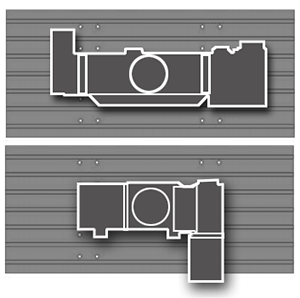
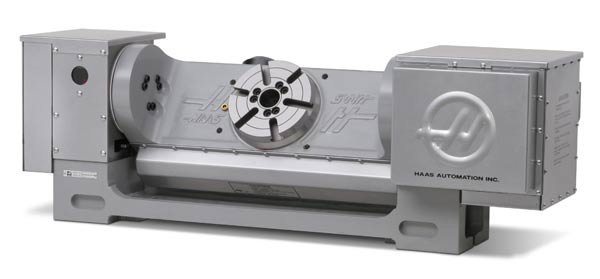
The Haas VF/VM series mills are available with optional 4th and 5th axis drives that provide the user with the ability to machine up to 5 faces on a component in a single setup or achieve complex surface machining though 5-axis motion.
Whilst being suitable for machinists producing complex components such as impellers or aerospace parts, everyone can benefit from multi-axis machine, simply adding a tilting 4th & 5th axis trunion table to your existing machine with a standard vice can reduce your setups for machining 6 sides of a block down to just two.
Not only is this a reduction in handling time and therefore direct cost but the elimination of additional fixturing stations will improve the dimensional accuracy and repeatability of the parts you manufacture and get them to the customer faster than before.
To make the process of utilising additional axis easier the Haas control includes a number of multi-axis orientated features to optimise the movements being commanded with innovative G-codes including:
These software features coupled with the industry leading ease of use features that Haas users already enjoy make the transition into multi-axis machining achievable for all machine shops.
(Please check with us if you machine is pre 2002 for software compatibility)
For Example: When a rotary fits with alternative fixturing, it may fit in that particular Haas mill, but will require a sub-plate or alternate T-slot for proper positioning. We have labeled this particular rotary and mill combination with a yellow caution
You can design and build your own sub-plate using the dimensions of your Haas mill and the dimensions of the rotary you'd like to use on that mill. Product dimensions are available for every machine and rotary on this website.
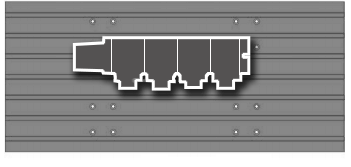
Single-Head Rotary Tables and Indexers are usually mounted to the right side of the table, with the rotary facing the centre of the machine. This is the basic setup we used to determine the fit of your rotary product.
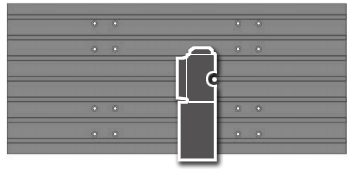
Image shown for mounting example purposes only. Your actual rotary and mill appearance may differ.

Trunnion Tables, T5Cs, and TRTs are usually mounted in the centre (or slightly off-centre) of the mill table. If you are using probing on the mill, be aware of the interference with larger tools, especially during tool changes.
NOTE: Trunnion units present interference issues with the swing of the unit relative to the machine column and spindle head.

Image shown for mounting example purposes only. Your actual rotary and mill appearance may differ.
Multi-Head Rotary Tables and Indexers are usually mounted toward the back of the table, with the indexer heads or platter facing forward. To mount a multi-head rotary in a different orientation, you must use alternative fixturing.

Image shown for mounting example purposes only. Your actual rotary and mill appearance may differ.
Important Information:
4-axis machines cannot use dual-axis rotaries.
Some options may affect mounting (EC-1600 4th-Axis Table, Low-Profile Tables, Table Spacers, Column Risers, etc.
Tool Changers: SMTCs and umbrella tool changers both present interference issues, plan appropriately.